
Checking Criminal History in Manchester
Manchester offers no single public criminal-history portal. Begin at the city level for the police report, then follow the event to county offices if an arrest or charge occurred. A person reviewing a known event should gather an approximate date, location, report or citation number, and the document sought. Those facts help the custodian locate an existing file without asking the city to conduct research or create a new summary.
- Identify whether Manchester Police made or investigated the event and note the date, place, and report number if known.
- Submit the City Clerk's required online open-records form for the police or city document.
- Call Clay County Detention Center if the question concerns a Manchester arrest that led to booking or current custody.
- Ask the Clay Circuit Court Clerk for the District Court citation, complaint, docket, order, or disposition.
- Use Kentucky Court of Justice or corrections channels only when a broader court report or later state custody record is needed.
The official Commonwealth-hosted Manchester city-officials directory gives a useful view of municipal contacts.
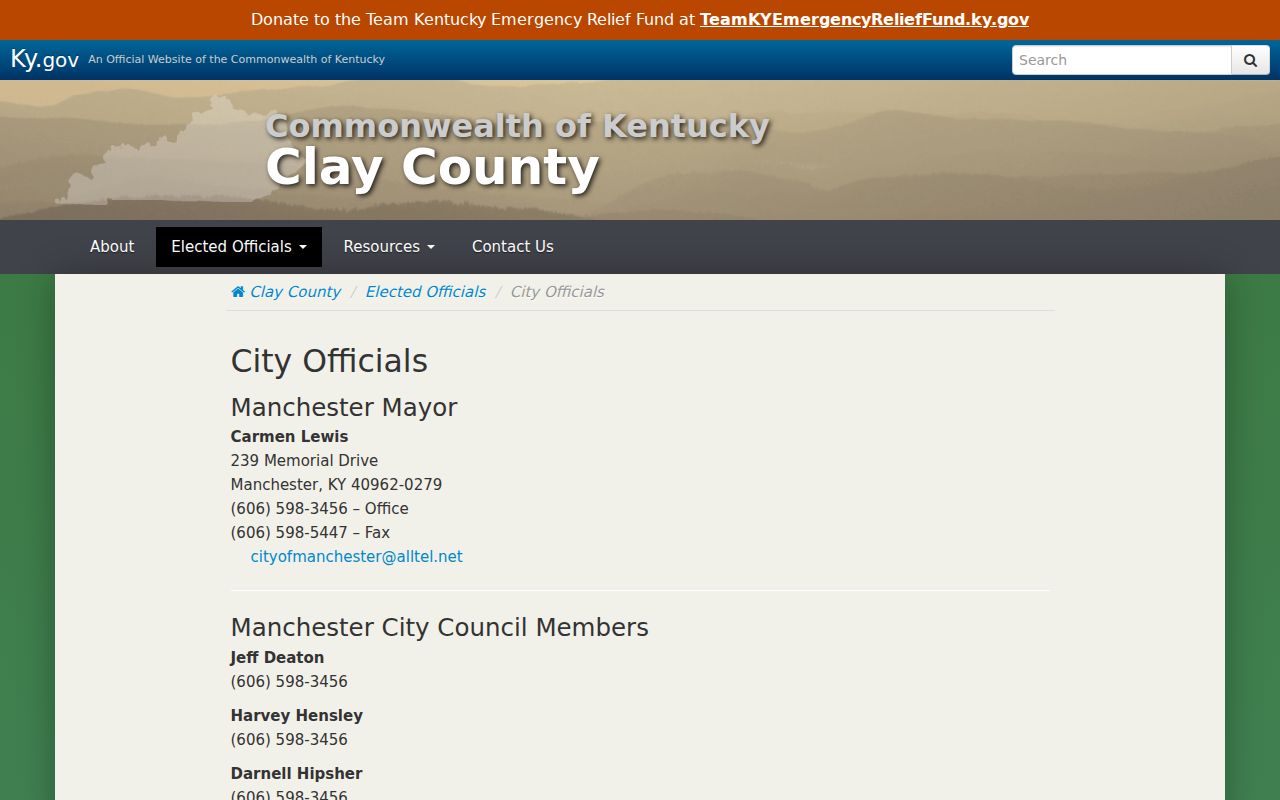
Current department and City Clerk pages should control when an older directory conflicts with newer contact details. Confirming the destination before sending a request prevents a city police document from being misdirected to the county clerk.
Manchester Police Record Request Route
Manchester routes all city open-records requests through the City Clerk at 207 Church Street, Manchester, KY 40962. The clerk's phone is 606-598-3456, email is clerk@cityofmanchesterky.org, and City Hall hours are Monday through Friday, 8:00 a.m. to 4:30 p.m. Calling first is useful if the record type or date is uncertain. No police-specific fee schedule or turnaround was found, so ask about cost, format, and delivery before ordering.
The official Manchester City Clerk page carries the required request form.

The form is simple, so the description box must do most of the work. Name the record, date and time, location, incident or report number, and desired medium. If several items are sought, describe each clearly. The page shows no upload control, record-type checklist, identity rule, fee, or promised response time.
| Form field | Required | How to use it |
|---|---|---|
| First and Last | Yes | Requester first and last name in separate text fields. |
| Yes | Give a monitored address for response or scope questions. | |
| Phone | Yes | Supply a number the custodian can use to clarify the request. |
| Records description | Yes | Enter type, date, place, number, and preferred format in the sole multiline field. |
| Submit | Action | No attachment option or extra record filter is displayed. |
Manchester Police Department Records
The current Manchester Police page says the department began in 1930 and names Chief Jeff Couch. Its office is at 200 White Street, Manchester, KY 40962. Nonemergency dispatch is 606-598-8411, while emergencies use 911. Dispatch can route operational questions, but requests for city records go to the City Clerk. That split keeps police response work distinct from the city's formal records-custodian role.
The official Manchester Police Department page documents the current agency address, dispatch line, chief, and history.

Manchester Police records may include incident and offense reports, arrest narratives, citations, and releasable related material. Ask for a specific existing item. An incident report describes the agency response and alleged facts. It is not the jail booking and does not certify the court outcome. No official Manchester police app, public blotter, report-search portal, or police fee list was located.
Manchester Records in Kentucky's Only Local City
Official Kentucky GIS identifies Manchester as Clay County's sole incorporated city. The 2020 Census counted 1,497 residents, while a current state profile displays a different figure without a clear vintage. The dated Census count is the safer comparison. Burning Springs, Oneida, and other Clay communities should not be treated as city governments with their own police or municipal record offices.
This status makes Manchester the county seat and the main city doorway into local justice records, yet city and county offices still keep different files. City Hall holds city requests. Manchester Police creates the incident record. The detention center records custody. The Justice Center keeps court papers. Short travel distances do not merge those custodians. A requester must still ask each office for the record it created.
Manchester Arrests and Bookings
Manchester has no published city jail. A person accepted after a local arrest is generally traced to Clay County Detention Center, 67 Shamrock Road, Manchester, KY 40962, phone 606-598-2133. Release or transfer can change location, so custody should be confirmed directly. No official Clay public booking roster or Manchester arrest blotter was found. An empty online search is therefore not proof that no arrest occurred.
The official Clay County Detention Center page identifies the Shamrock Road facility and its local operations.

The facility makes the booking record after intake, including a booking number, arresting agency, preliminary charges, custody, and bond fields where releasable. Manchester Police keeps the report describing the alleged event. The Clay clerk keeps the court's complaint, bond order, and final result. KOOL becomes relevant after KDOC incarceration or supervision begins, not immediately after every Manchester arrest.
When Manchester Police Made No Arrest
An event inside or near Manchester may involve the Clay County Sheriff, Kentucky State Police, or another task force. In that case, the City Clerk may hold no responsive police report. Identify badges, agency names, citation headers, or the court complaint before sending the request. The arresting agency owns its narrative even if detention occurred at the county facility.
Use the sheriff at 606-598-3471 for sheriff-created reports. KSP provides its own open-records process for trooper records. Ask the detention center for booking and custody details, then call the trial-court clerk for the public case. This agency-first method is especially important in Manchester because city, county, and state officers can all create records that later reach the same Clay court.
Municipal Court Records in Manchester
Manchester does not have a separate public municipal docket portal for ordinary city cases. Under Kentucky's court structure, Clay District Court handles city ordinances, traffic matters, violations, misdemeanors, arraignments, and felony probable-cause proceedings. If a felony is indicted, the later prosecution moves to Clay Circuit Court. Both local trial-court record sets are maintained by Circuit Court Clerk Leslie Phillips at the Clay County Justice Center.
| Court name | Clay District Court for ordinances, traffic, violations, misdemeanors, and the first felony stage; Clay Circuit Court after felony indictment. |
|---|---|
| Record counter | Clay Circuit Court Clerk, 316 Main Street, Suite 108, Manchester, KY 40962; 606-598-3663. |
| Lookup inputs | Party name, approximate year, court or case type, case or citation number, and requested document. |
| What the file shows | Complaint or citation, docket events, bond and other orders, charge changes, disposition, judgment, and sentence as applicable. |
| Copies and fees | Ask for plain or certified copies and delivery choices; no local copy fee was confirmed in the research. |
Ask for the docket and final order, not just a charge line. A city citation or booking charge may change. The clerk can also explain whether an older Manchester file is onsite, archived, or must be retrieved. CourtNet can provide broader Kentucky court data, but the clerk's file remains the official source for a particular case.
Reading Manchester Criminal Record Counts
FBI Crime Data Explorer identifies Manchester Police as ORI KY0260100 and a NIBRS participant since 2009. For 2024, the official summarized endpoints report three violent crimes, all aggravated assaults, and 12 property crimes: three burglaries, seven larceny-thefts, and two motor-vehicle thefts. The participated population was 1,400 each month. Counts are more useful here than unstable rates for a small population.
Those figures describe offenses known and reported by Manchester Police. They are not every offense in Clay County, not arrest totals, and not conviction totals. Sheriff or KSP cases are outside that city-agency count. Reporting coverage and missing months can also affect comparisons. A crime-data count should never be used to infer what happened in a named person's case. The police report and court disposition answer that question.
Where Manchester Records Go
A Manchester event can create several records in sequence. Police make the first incident or arrest report. If custody follows, Clay County Detention Center creates a booking. Clay District Court opens the complaint, citation, first-appearance, and bond trail. An indicted felony moves to Circuit Court. Reported court dispositions can later appear in AOC CourtNet, while fingerprint and charge data may enter Kentucky State Police systems.
Record flow: Manchester Police › Clay County Detention Center › Clay County Courts › Kentucky State Police
Each step answers a new question. The city report describes what police alleged and did. Booking shows intake and custody. Court papers show filed charges and the outcome. AOC provides a statewide court-derived view. KSP maintains the central criminal-history repository, but its public conviction request is mail or walk-in based and requires the subject's permission. For broader county routes, use the Clay County criminal history overview.
Manchester Record Portals That Do Not Exist
Manchester's official directory is a contact source, not a criminal-record database. No city jail, police blotter, arrest gallery, warrant search, municipal-case portal, police app, or online report-status tracker was verified. That sparse web footprint makes phone and form access substantive parts of the records process. It does not justify using an unofficial people-search or mugshot site.
Use the City Clerk form for city records, dispatch for police routing, the detention center for custody, and the clerk for court documents. When an office has no published fee or turnaround, ask before ordering. When a request is denied or redacted, preserve the response and its stated legal basis. The Kentucky Attorney General supplies an open-records review route under state law.
Manchester History and Record Geography
Manchester was incorporated in 1844 and is known locally as the City of Hope. The city and county's modern justice buildings sit near downtown, but their roles remain distinct. Manchester Police dates to 1930. City records route through the Church Street clerk, police operations are on White Street, county court files are at Main Street, and detention information is on Shamrock Road. This compact geography can make separate offices look like one system when they are not.
The official Goose Creek Swinging Bridge page shows the restored bridge joining Riverside Trail and downtown.

The bridge and Land of Swinging Bridges identity supply local context, not a records office. They help explain why Manchester is the civic center while reinforcing the need to distinguish a city landmark, City Hall, police, court, and detention locations.
Public Access Rules in Manchester
Kentucky law opens many existing public-agency records while allowing exemptions and redactions. Request Manchester Police material through the City Clerk. Ask the Clay clerk for court records. Active investigations, juvenile material, protected victim information, personal identifiers, and records covered by another confidentiality rule may be withheld. A denial should identify its legal ground. Public access never turns an allegation into guilt.
Key Statutes:
Kentucky Open Records Act, KRS 61.870-61.884 establishes public-record inspection, copying, exemptions, response duties, and review.
KRS 17.150 addresses inspection of law-enforcement records after prosecution is complete, subject to statutory exceptions.
KRS 431.073 governs petitions to expunge eligible convictions and sets limits and procedures.
Ask for releasable portions when a document includes protected material. An agency may redact exempt facts rather than withhold the whole record when the parts can be separated. If a court result or police entry appears wrong, obtain the source document and use the correction process of the office that created or reported it.